How to Correct the Pilates Supine Spine Twist
Jan 04, 2017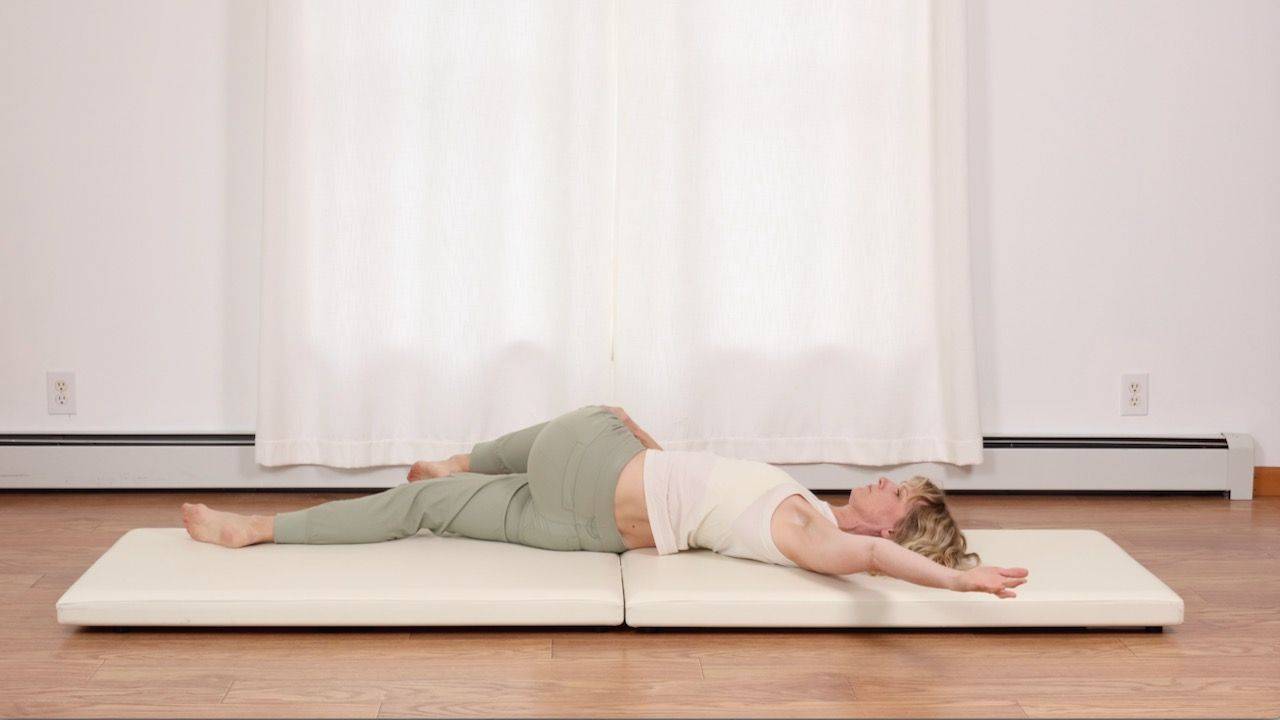
A Pilates teacher once asked me this question:
In Supine Spine Twist, when my client's legs rotate to one side and the opposite shoulder starts lifting off the mat, should I correct the shoulder? Should I use a verbal or tactile cue?
It's a great question because it gets at something much bigger than how to correct one Pilates exercise.
When you see something you don't like in an exercise, don't immediately correct what you see. First ask why it's happening.
Why Does the Shoulder Lift in Supine Spine Twist?
In Supine Spine Twist, we're asking for rotation through the trunk while the upper body remains relatively stable.
But every person's available range of motion is different.
As the legs move farther to the side, your client may eventually reach the limit of the movement they can create while maintaining the position of the upper body. At that point, something else has to move if they want to keep going.
The shoulder lifting may simply be the compensation that allows them to lower the legs all the way to the floor.
This is why I wouldn't start by pushing the shoulder back onto the mat.
You're correcting the compensation rather than addressing the reason the compensation appeared.
Instead of Correcting the Shoulder, Back Up
Bring your client back to the starting position.
Then ask them to perform the movement again—but this time, slowly.
Watch what happens.
As the legs begin moving to the side, can the client maintain the relationship between the rib cage, shoulder girdle, and mat? Are all four sides of the torso evenly long?
In anatomical terms, this means we’re looking for trunk stability on the frontal and sagittal plane. Not on the transverse plane, obviously, because we’re moving into spine rotation.
Keep going.
At what point does the opposite shoulder begin to lift?
That's the interesting part.
The client will begin to compensate when they have reached their end range of motion into rotation. They will most likely extend the spine or lift the shoulder. This way they can do what you’re asking (lower the legs to the ground).
Instead of pushing the shoulder down and continuing farther into the twist, stop just before the compensation occurs.
For this, I would choose the Side To Side exercise. With both legs bent and together, begin in table top, and slowly ask them to lower the legs towards the floor until they notice the opposite shoulder lifting and then hold the position.
You have now found the range in which your client can currently perform the movement with the control you're looking for.
That may be a much smaller movement than you expected.
That's okay.
More range isn't automatically better.
A Cue Should Help the Client Create the Movement
If you want to use a tactile cue, try sliding your fingers underneath the client's upper back, just below the armpit.
Instead of pushing their shoulder toward the mat, ask them to gently press your fingers into the mat.
There's an important difference here.
You're not putting the client into the position. You're giving them information that helps them create the position themselves.
The same principle applies to verbal cues.
Instead of: "Keep your shoulder down."
You might say: "Move your legs only as far as you can while keeping the back of your shoulder connected to the mat."
Now you've given your client a movement problem to solve rather than a position to imitate.
But There's Another Question We Need to Ask
This is where Pilates teaching gets interesting.
If the shoulder repeatedly lifts at a particular point, why?
Is there enough mobility available for the movement we're asking for?
Is the mobility available, but the client doesn't yet have the control to organize the movement?
Do they understand what you're asking them to do?
Are they simply trying to create a bigger range of motion because they think farther is better?
Or is something else influencing the movement?
This is why cueing alone doesn't solve every movement problem.
Sometimes the client doesn't need a better cue.
They need a different exercise.
Don't Just Correct. Investigate.
This is one of the central ideas behind the ADAPT Pilates Method.
When you notice something unexpected, resist the urge to immediately fix it.
Observe what happens.
Investigate why it's happening.
Learn from what changes.
For example, you could reduce the range of the Spine Twist and see whether the client can control it.
You could change the position of the legs.
You could explore trunk rotation in a different relationship to gravity—perhaps seated, side-lying, quadruped, or standing.
Each change gives you more information.
Instead of repeatedly telling your client to "keep your shoulder down," you're beginning to understand why the shoulder comes up in the first place.
And that's a much more useful teaching skill.
So, Should You Push the Shoulder Down or Not?
The answer is: it depends on the person.
With some clients, I might gently push the shoulder toward the mat because I know their body well and I intentionally want to help them access a little more stretch. With another client, I might know from experience that they don't respond well to additional stretch or external assistance, so I wouldn't. And with someone who's new to me, I generally do very little correcting at first. I'm still learning how their body moves and responds.
But there's one thing I would do with all of them: educate them.
I want every client to understand why they're doing the exercise and what we're trying to achieve with it. Once they develop that embodied understanding, they can begin to recognize and correct the movement themselves.
And that makes my job much easier.
Instead of constantly correcting every person, I can spend my attention on the clients who don't yet have that understanding—or who need my help for another reason.
The goal isn't to create clients who need better corrections. It's to create clients who increasingly understand their own movement.
The Bigger Lesson
It's tempting to think that good Pilates teaching means knowing the correct position for every exercise and having the perfect cue ready whenever your client deviates from it.
But real bodies aren't that simple.
When something unexpected happens during an exercise, think of it as information.
Don't immediately ask: "How do I correct this?"
Ask: "Why might this be happening?"
That question turns a correction into an investigation—and helps you choose the next exercise based on what the person in front of you actually needs.